Who I am
as a builder.

I use AI to make difficult things tangible: a personal friction, an unfamiliar technology, an interaction I want to understand.

I build from lived friction.

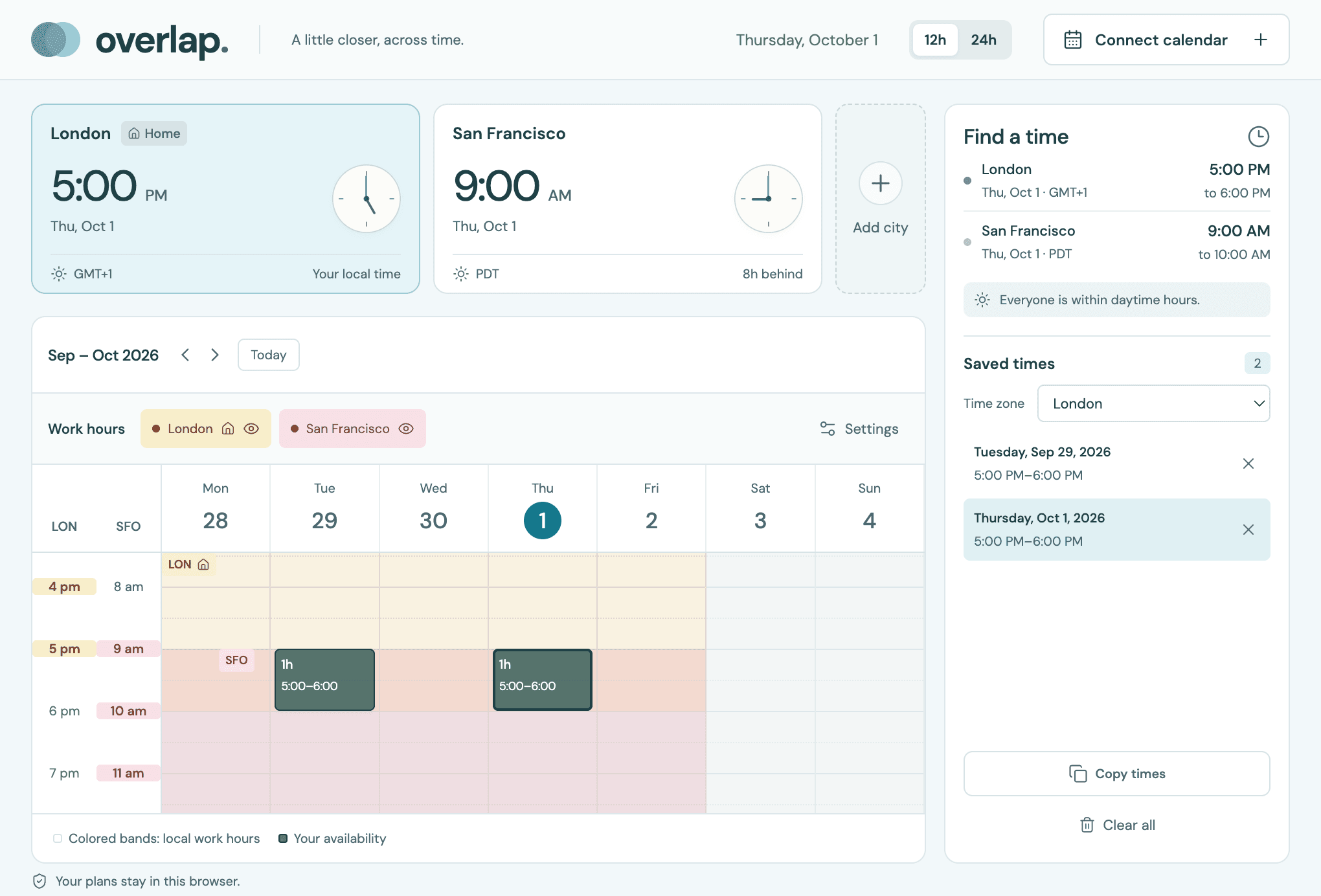
Overlap's London and San Francisco clocks, weekly calendar with work-hour bands, and saved availability

Overlap

A clear way to find overlapping times across cities.

The pain point
Scheduling interviews from London across San Francisco and New York turns every availability note into timezone arithmetic. I needed a clearer way to convert time across cities.
My intention
Build a private planner that helps me find a time that works across cities and share it in each person’s local time.
What I made
A local-first world clock and availability planner with calendar imports, work-hour overlaps, DST-safe times, and copy-ready messages.
GitHub repo
How I Am Today symptom tracking interfaceCycle-aware by design

How I Am Today

A symptom tracker designed around the rhythm of chemotherapy.

The pain point
Chemo side effects repeat in cycles, but most symptom trackers treat every day as an isolated entry. Important patterns and questions can disappear between visits.
My intention
Help patients anticipate difficult days and arrive at care visits with a clearer memory of what happened.
What I made
A cycle-aware tracker for symptoms, infusion dates, prior-cycle comparisons, and questions for the care team.
Read the project
TodayEvidence first
Product DesignerTailor from verified workDrafting
Design EngineerReview application packetReview
AI Product LeadReconcile recruiter updateWaiting
AI assists. Sue decides.

Rolecraft

A private, evidence-grounded workspace for the job search.

The pain point
A job search scatters facts, deadlines, messages, and drafts across too many tools. AI can also sound confident about something it cannot prove.
My intention
Use AI for the repetitive work while keeping evidence, judgment, employer contact, and submission under human control.
What I made
A Supabase-backed workspace that researches opportunities, tracks applications, reconciles recruiting evidence, and prepares review-ready materials.
The Reservoir knowledge graph interface

The Reservoir

What if saved links became shared team memory?

What I made
Designed and built an AI knowledge base with summaries, semantic search, recommendations, and a D3 knowledge graph.
Read the project

Audit AI

Can AI catch contradictions inside a finished report?

What I made
Explored a PDF-first workflow that checks narrative and chart claims against table values, including implicit comparisons.

Interview Lens

Can research synthesis use AI without exposing raw interviews?

What I made
Built a private transcription, PII-redaction, approval, reporting, and cited Q&A workflow where only approved excerpts reach AI.

Studies for fun, and for finding the edge.

Small studies are where I can ask stranger questions. The brief or prompt is open because the human input is part of the work.

Live study

A design agent lives here

A site that can restyle itself from a visitor's words, then audit the result instead of trusting its own taste.

Study brief
“Let a visitor describe a vibe. Stream the agent's design decisions as it changes the page, then check contrast and repair anything that fails.”

The interesting part was not generation. It was making taste visible, reversible, and accountable to a basic quality check.

Live study

ASCII fluid

A fluid simulation that speaks in terminal characters instead of pixels.

Study brief
“Make a responsive field where dragging injects energy. Advect, diffuse, and decay it, then render the result through a ramp of monospace glyphs.”

I wanted the interaction to feel physical even though its material is only text.